• Skip to primary navigation
  • Skip to main content
  • Skip to footer

Pimachiowin Aki

World Heritage Site

  • News
  • Resources
  • Visit
  • Home
  • Shop
  • Donate
  • Contact
  • About Us
    • Pimachiowin Aki Assembly of Partners
    • Board of Directors
    • Timeline
    • Communities
      • Bloodvein River First Nation
      • Little Grand Rapids First Nation
      • Pauingassi First Nation
      • Poplar River First Nation
    • Annual Reports
  • Keeping the Land
    • Our Work
    • Cultural Heritage
    • Wildlife and Habitat
    • Sustainable Economies
    • Guardians Program
      • Colin
      • Melba
      • Owen
      • Dennis
    • Education
  • The Land That Gives Life
    • Boreal Forest
    • Calendars
    • Climate
    • Cultural Sites
    • Habitation
    • Harvesting
    • Language
    • Named Places
    • Plants
    • Travel Routes
    • Water
    • Wildfire
    • Wildlife
  • Fast Facts
  • Search
  • Facebook
  • Twitter
  • Instagram
  • YouTube

Archives for December 2025

Year of Collaboration: 7 Highlights

December 8, 2025


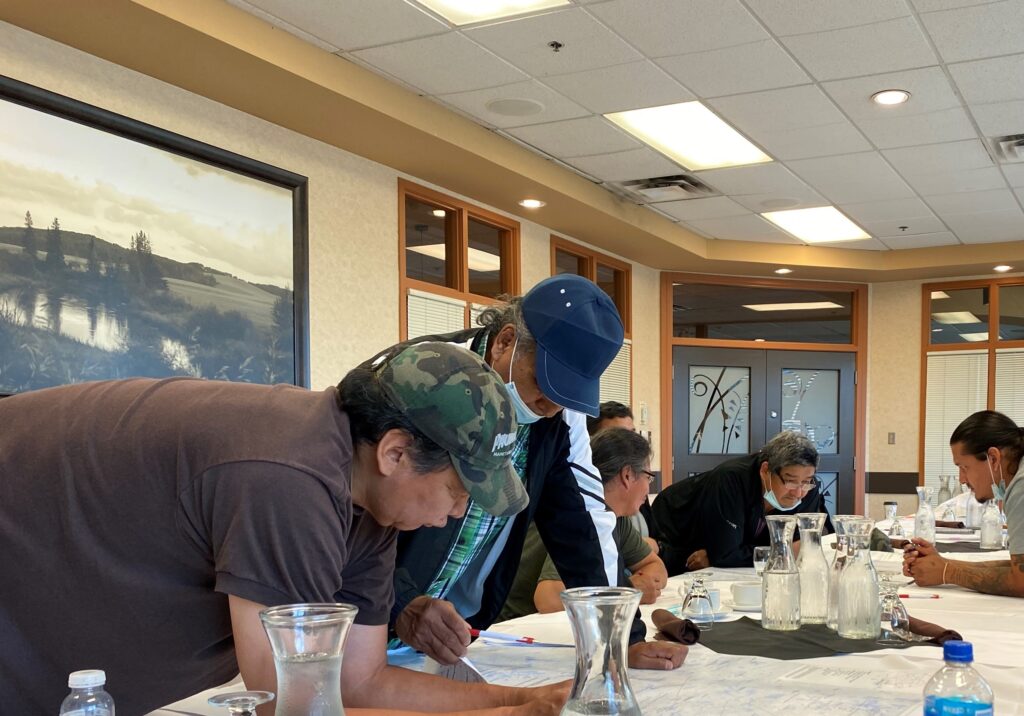
This year, Pimachiowin Aki achieved several milestones that highlight the power of collaboration. Residents and visitors can now see new site signs, Guardians strengthened their skills through hands-on training, and communities are working to restore traditional place names for ancestral lands. We also welcomed new Board members, prepared to share our OUV in Anishinaabemowin, and launched our first online shop! These accomplishments reflect the dedication of communities and partners to care for the Land that Gives Life. Here are seven highlights:

1. New Signs on the Land
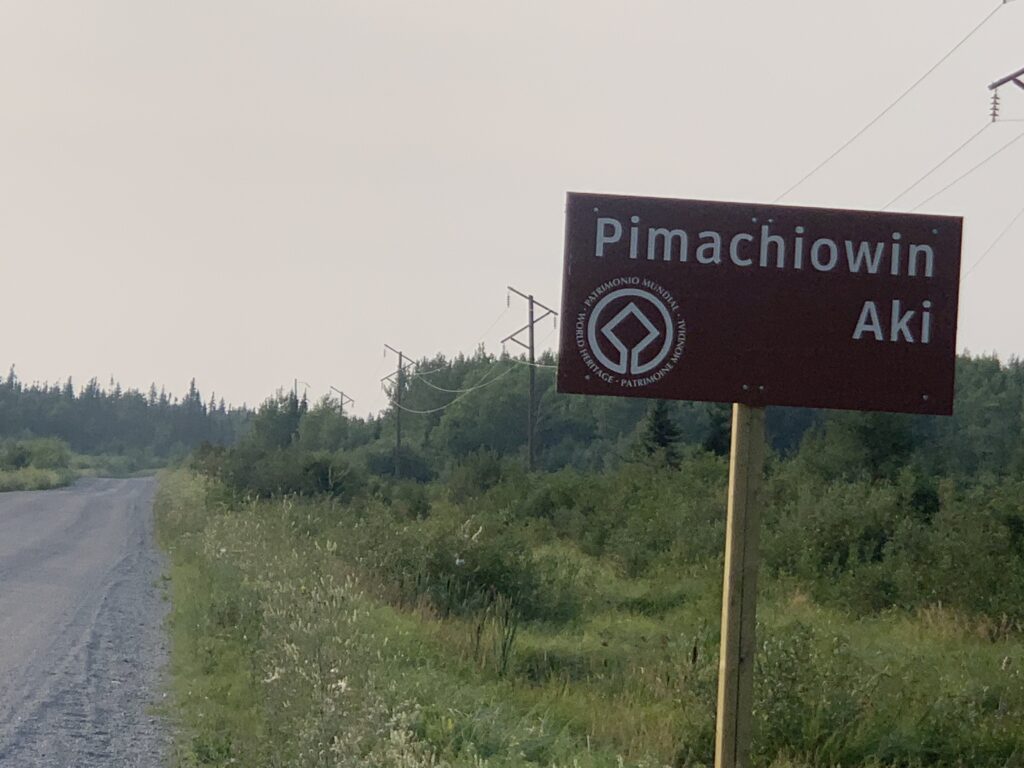
Photo: Gerald Neufeld

This summer, five new World Heritage Site signs appeared along PR 304, our very first in Manitoba! Manitoba Transportation and Infrastructure (MTI) worked with Pimachiowin Aki to design and install the signs, which mark the site boundary and help travellers find their way. These signs follow provincial road standards and UNESCO guidelines, making them official and built to last.

Pimachiowin Aki partners are grateful to everyone at MTI and UNESCO who helped bring this long-awaited project to life.

2. Guardians Complete 200-Hour Program
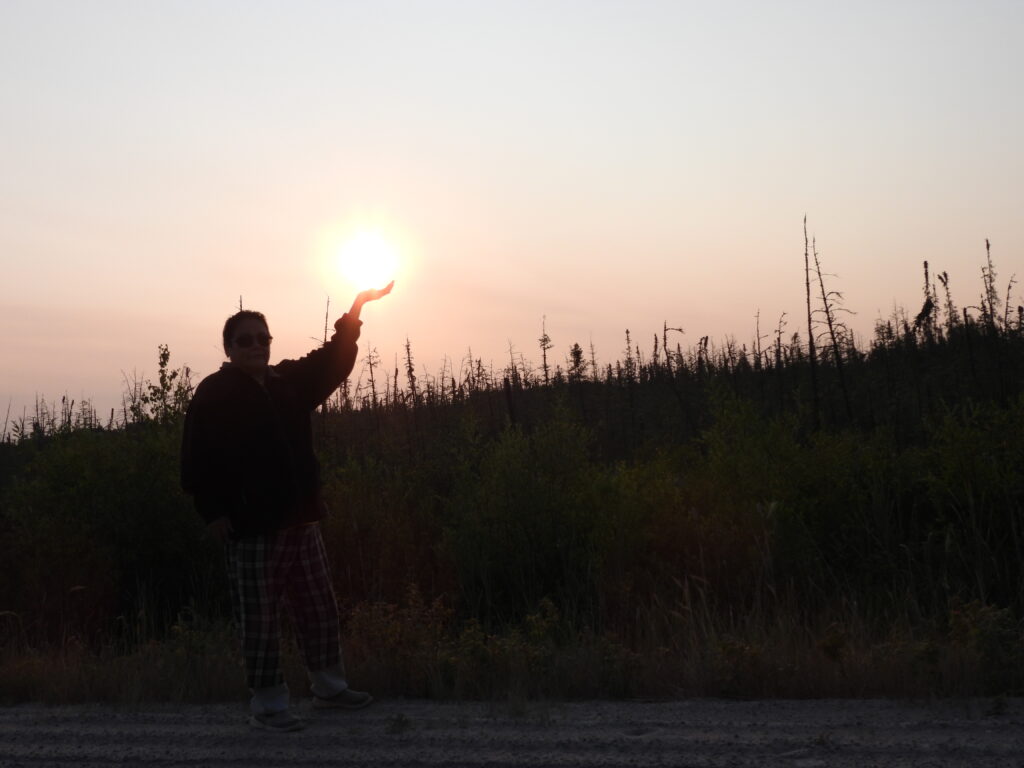
Photo: Melba Green

Pimachiowin Aki Guardians Melba Green and Owen Bear completed the intensive five-week Land Guardian Program through the Natural Resources Training Group. They attended lectures, trained in the field, learned to identify plants, birds, fish, wildlife and habitat, and sharpened their environmental monitoring skills.

The program strengthens the important work happening right now in Bloodvein River and Poplar River, provides opportunities for future employment in land management and environmental protection, and meets academic requirements for an Applied Biology Technician program.

Congratulations, Melba and Owen!  

3. New Leaders Join the Board
Enil Keeper

Enil Keeper
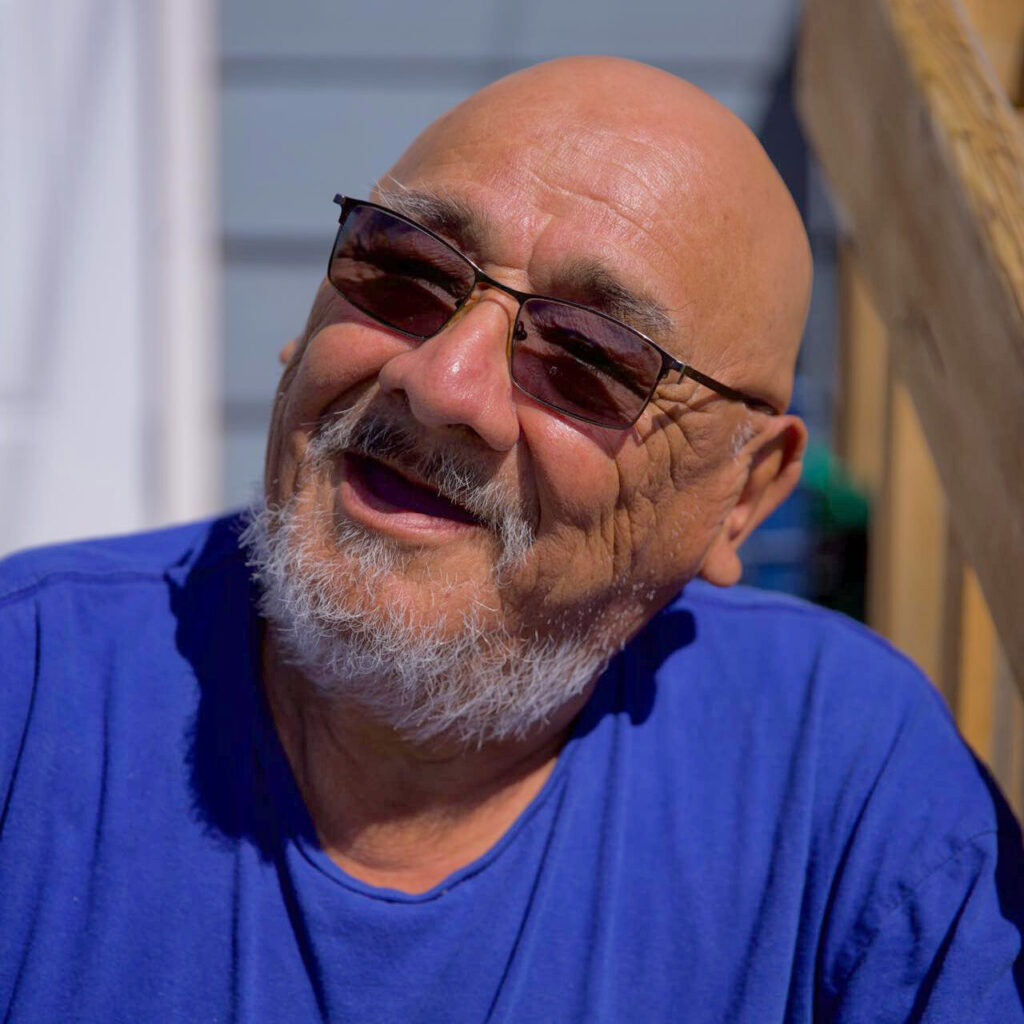
Little Grand Rapids First Nation has a new representative on the Board. Enil Keeper—former Chief, long-time Councillor, RCMP officer, assistant Conservation Officer, Home-School Coordinator, and lifelong learner—brings deep community knowledge and decades of experience to this position. Born on Sharpstone Lake and raised on the land, Enil has been part of the Pimachiowin Aki journey from the beginning. He follows Augustine Keeper, who contributed more than a decade of leadership and vision.
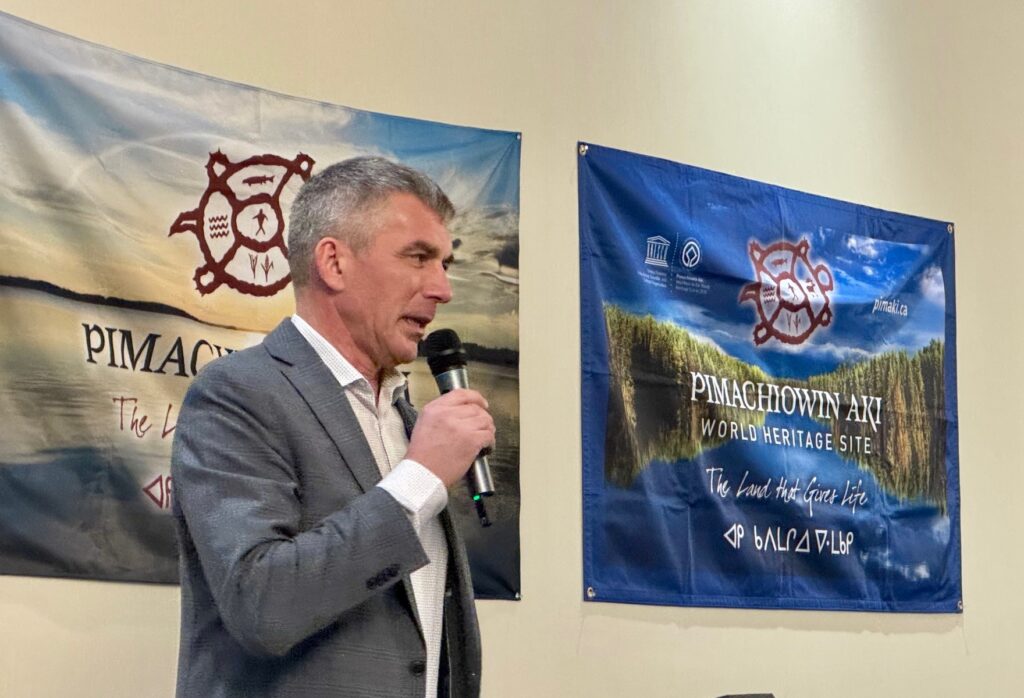
Rob Nedotiafko

Rob Nedotiafko
Rob Nedotiafko was appointed to represent the Government of Manitoba on the Board of Directors. Rob worked closely with Poplar River First Nation on the Asatiwisipe Aki Land Management Plan and now serves as Director of Parks for Manitoba Environment and Climate Change. He steps into the role held for 16 years by Bruce Bremner, whose dedication continues to shape our work today.

Waajiye/Welcome, Enil and Rob
Aapiji miigwech/Many thanks to Bruce and Augustine

4. Our OUV—Now in Anishinaabemowin
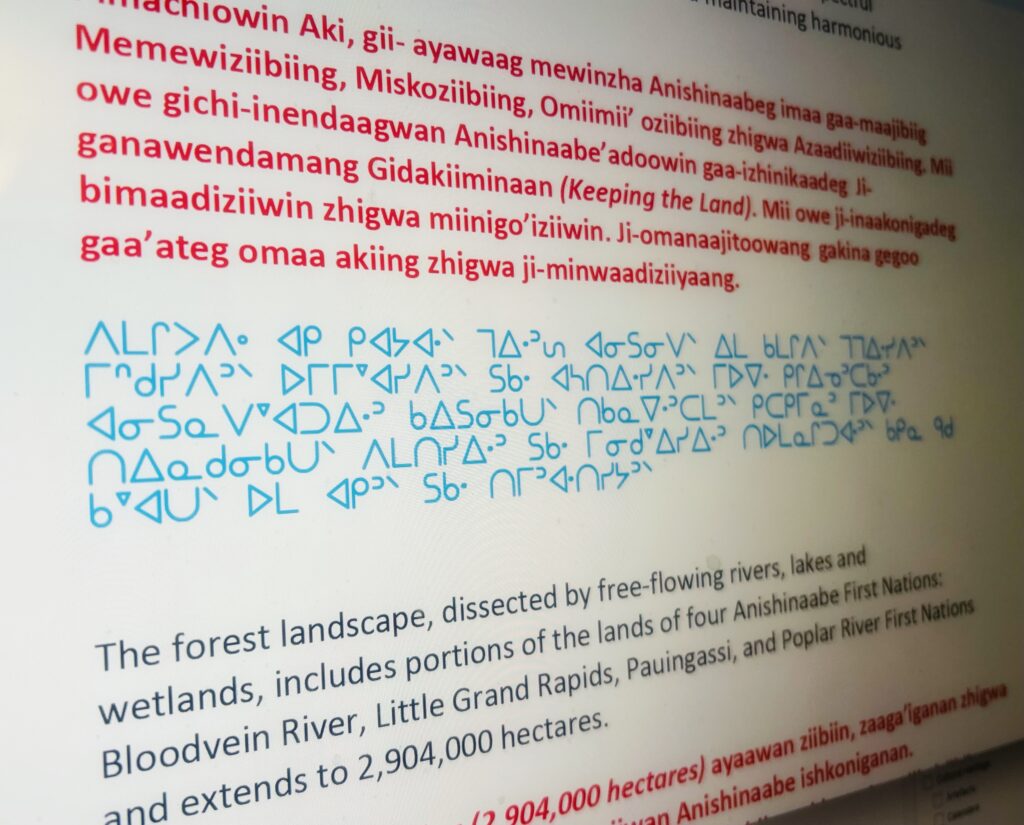
The translated OUV, still in its draft stage

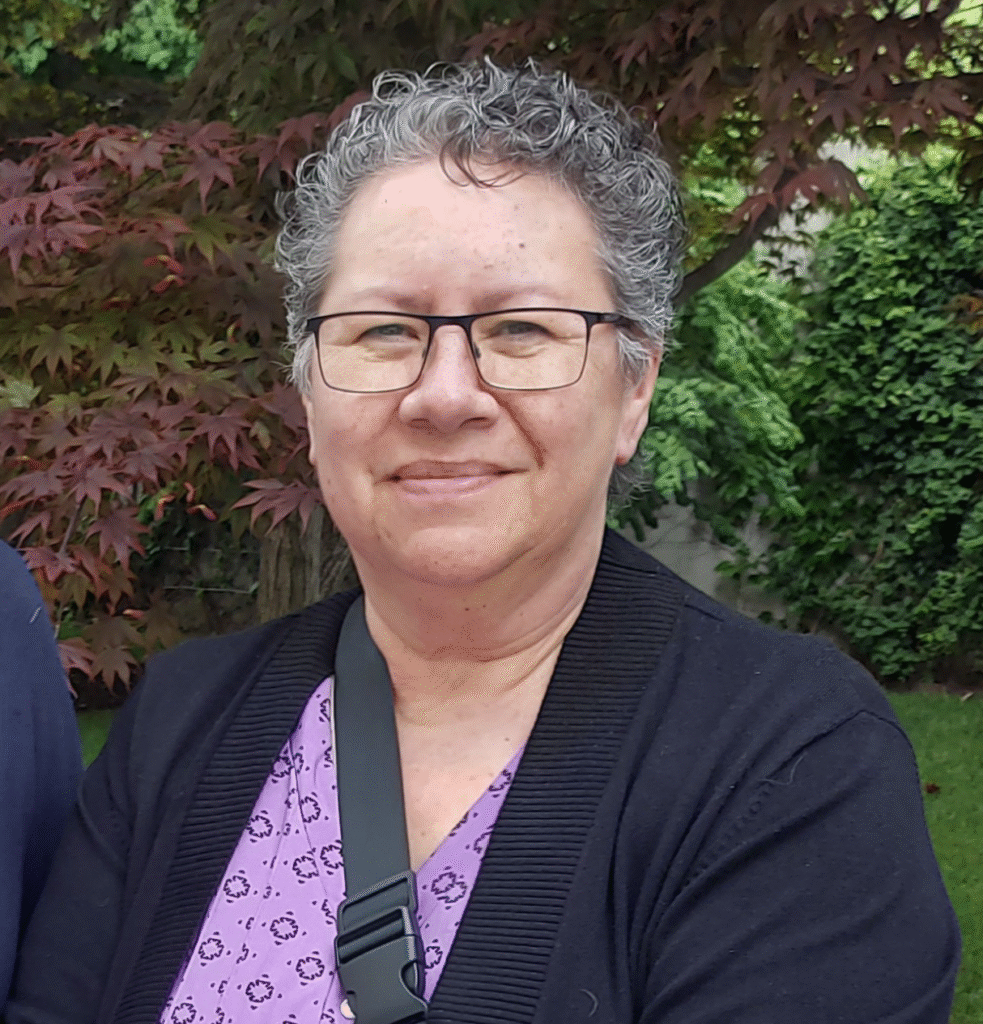
Pimachiowin Aki’s Statement of Outstanding Universal Value (OUV) will soon be available in Anishinaabemowin—in Roman orthography and syllabics. This translation, completed by Carol Beaulieu and supported with a grant from Parks Canada, brings the language of the land to this important UNESCO text.

The OUV explains why Pimachiowin Aki matters to the world and has cultural and natural significance for all peoples, now and for future generations.

The translated version will be shared on our website and with schools once approved by Pimachiowin Aki partners. Please contact your Director if you would like to review the draft statement.

Outstanding Universal Value means cultural and/or natural significance which is so exceptional as to transcend national boundaries and to be of common importance for present and future generations of all humanity. As such, the permanent protection of this heritage is of the highest importance to the international community as a whole.

—para. 49, Operational Guidelines for Implementation of the World Heritage Convention

Carol shares her story about the translation process > Guided by Teachings—Carol’s Approach to Translation

5. Bringing Traditional Place Names Back to the Map
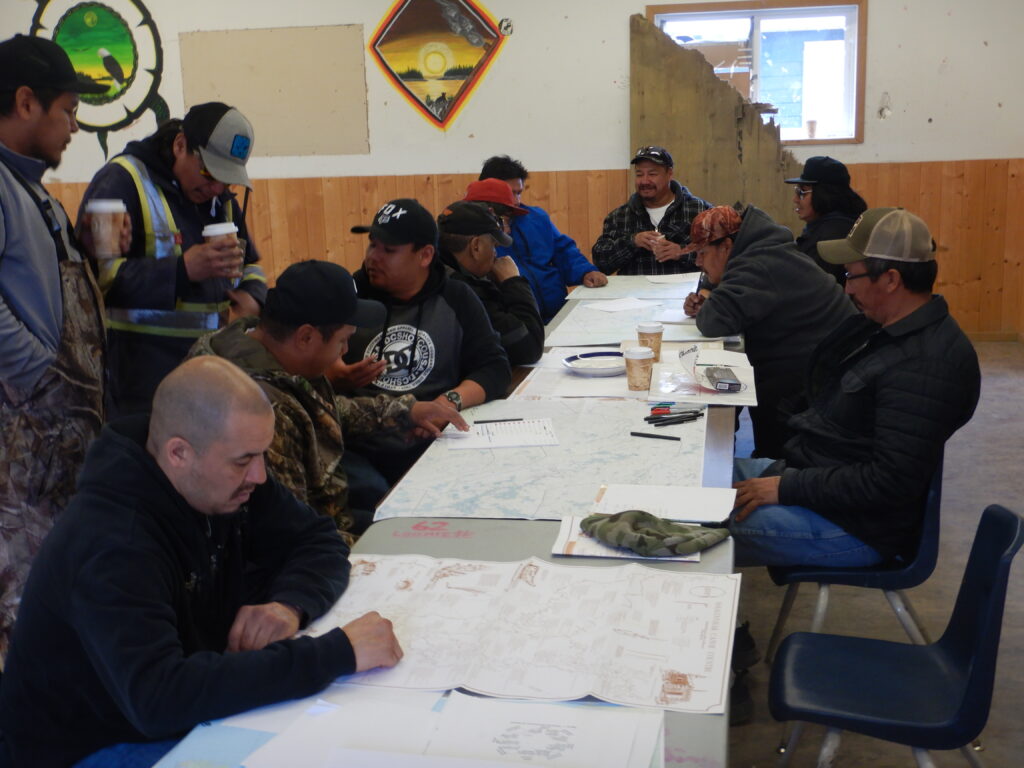
Mapping in Little Grand Rapids First Nation

Little Grand Rapids and Pauingassi First Nations continued their Traditional Place Names Projects this year, working with Elders, knowledge keepers, Manitoba’s Provincial Toponymist, and a Master’s student. Draft maps are now ready for community review—the moment where Elders confirm spellings, stories, and accuracy.

Once complete, maps will be shared in schools and community spaces. The First Nations will also decide which names to make official so they can appear on Google Maps and future topographical maps.

Miigwech to Manitoba’s Lands and Planning Branch for providing GIS mapping support and helping this project grow.
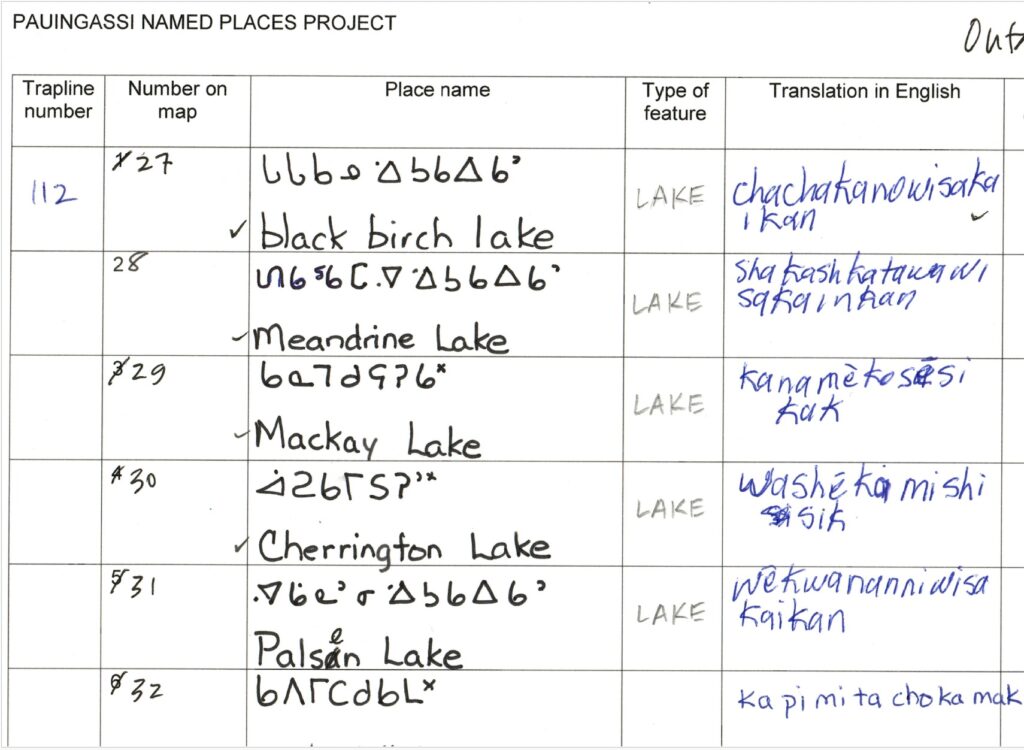
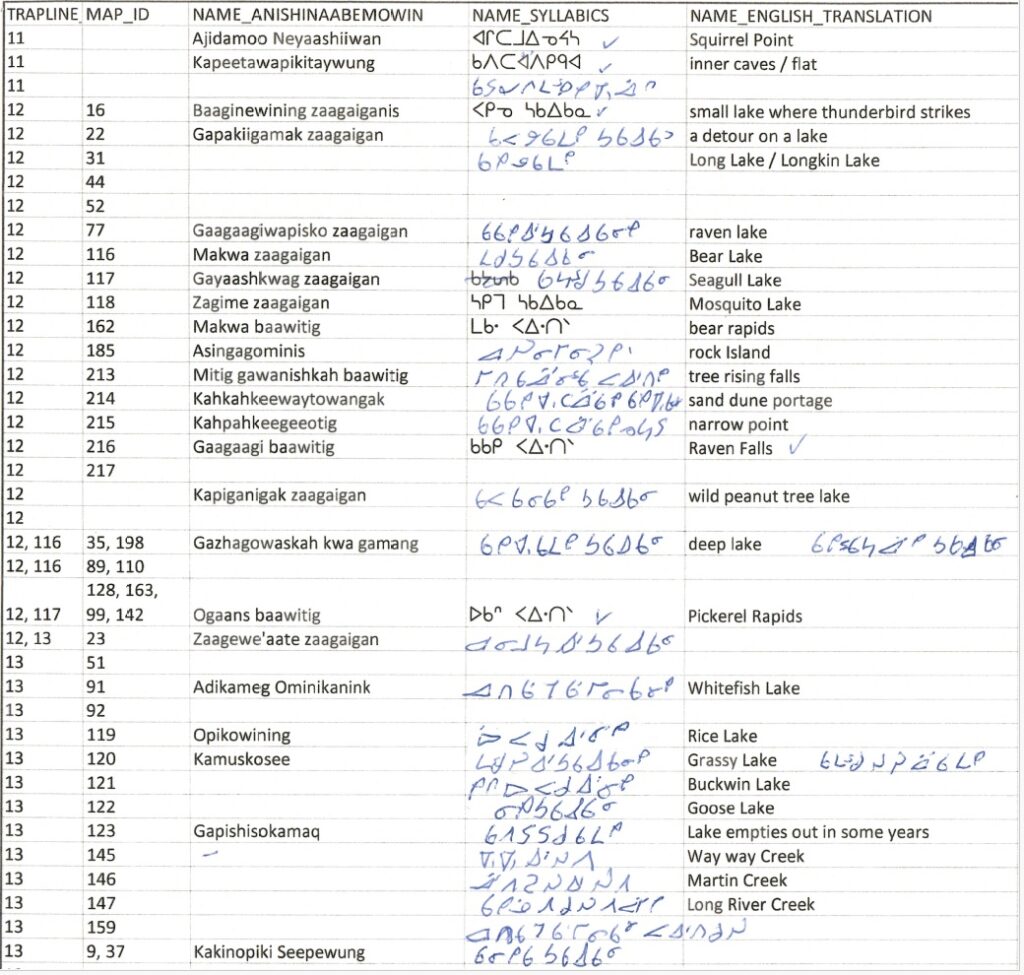
Excerpt from Pauingassi First Nation
Excerpt from Little Grand Rapids First Nation

6. A Top Score for Pimachiowin Aki

Photo: Melba Green

The International Union for Conservation of Nature (IUCN) World Heritage Outlook assesses the health of natural and mixed World Heritage Sites every 3–5 years. In 2025, Pimachiowin Aki received the highest possible conservation outlook.

Drawing on insights from hundreds of experts and partners, this global assessment tracks the state of conservation of all natural and mixed World Heritage sites and raises awareness of their importance. It also serves as an early warning system, helping identify threats and guide actions needed to safeguard the world’s wonders.

Pimachiowin Aki’s outlook is a powerful reminder that when communities, governments, Guardians, and supporters work together, we can protect one of the world’s most important ecosystems and cultural landscapes. The full report is available here: https://worldheritageoutlook.iucn.org/explore-sites/pimachiowin-aki

7. Our New Online Shop
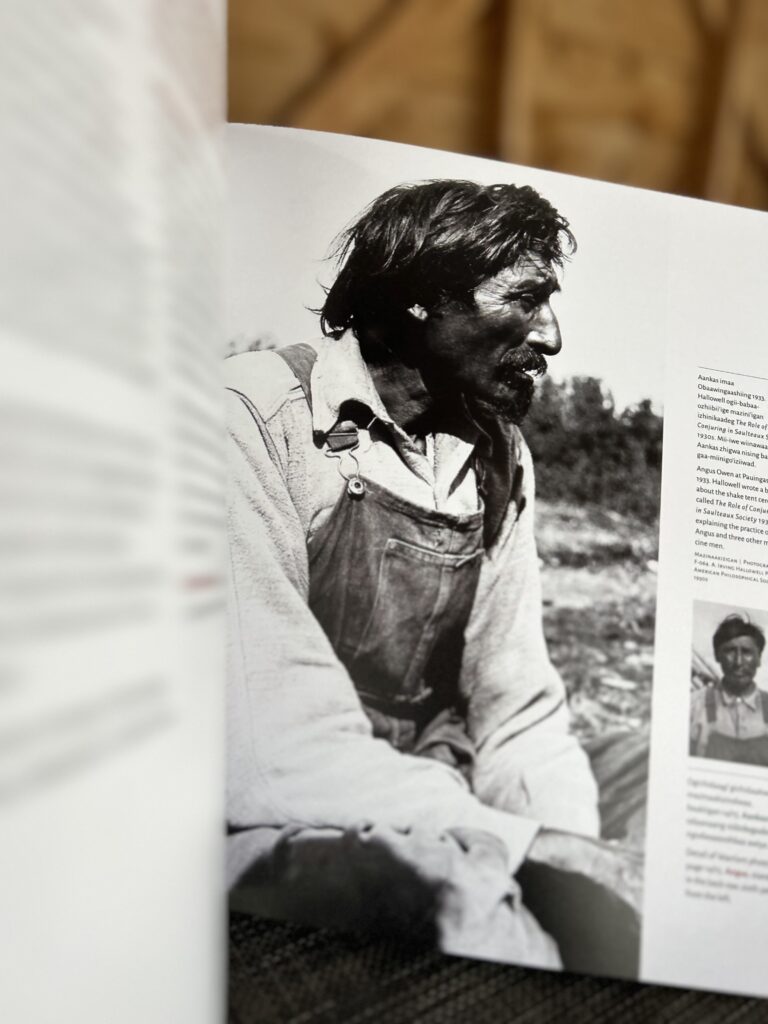
Page from Obaawingaashiing Gichi-Aabijitaawinan – The Pauingassi Collection

Pimachiowin Aki has launched an online store! For now, supporters who donate $300 or more to the Pimachiowin Aki World Heritage Fund at The Winnipeg Foundation receive a copy of Obaawingaashiing Gichi-Aabijitaawinan – The Pauingassi Collection as a thank-you gift. Miigwech to everyone who made this possible, including:

  • Maureen Matthews, Elaine and Joshua Owen, (late) Roger Roulette, and Carol Beaulieu for creating the book
  • Manitoba Museum for publishing the book as part of the Nametwaawin Outreach Project funded by Heritage Canada with a contribution from Pimachiowin Aki
  • A donor-advised fund at The Winnipeg Foundation for a significant contribution toward the cost of printing the books
  • Peaceworks Technology Solutions for programming our new Shop page
  • Everyone who invested in Pimachiowin Aki this year through your donations, grants to our programs, and in-kind contributions. We thank you for placing your trust in us to steward these resources and maximize their impact

Every Dollar Helps Protect Pimachiowin Aki
In the future, we hope to offer books, maps, posters, and even branded apparel directly through the Shop to support our programs.
Donate Today

Filed Under: Indigenous Language, Land Guardians, Named Places, Uncategorised, UNESCO World Heritage Tagged With: guardians, Pauingassi First Nation

Guided by Teachings—Carol’s Approach to Translation

December 8, 2025

If Anishinaabemowin is your first language as a baby and for the rest of your life, you will be Anishinaabe always and will be connected through the language.

For translator Carol Beaulieu, language carries a deep responsibility. Guided by the teachings she grew up with and the legacy of the late Roger Roulette, she translated Pimachiowin Aki’s Statement of Outstanding Universal Value in Anishinaabemowin. In this Q&A, Carol shares her process, the challenges and choices behind the words, and her work to preserve Anishinaabemowin for future generations

1. You translated Pimachiowin Aki’s Statement of Outstanding Universal Value (OUV) in Roman Orthograhy and Syllabics. Can you walk us through your translation process? Where did you begin, and how did you ensure accuracy and cultural integrity?

First of all, thank you for trusting me with this translation. I read the content numerous times and researched translations by the late Roger Roulette. We were close friends for many years. He was an expert in translation, transcription, reading, writing, and the linguistics of Anishinaabemowin. I wish I had taken the time to be directly mentored by him, but I did pick up things along the way which helped me complete the translation. 

This is the way I try to do it. I read the English a number of times so that I understand the message clearly because I understand one does not translate directly (word for word) but contextually. In this particular translation, I had translations that Roger had done as part of the Pimachiowin Aki project. Part of translating is to not re-invent the wheel but take what already exists and edit it for your translation. Since Anishinaabemowin is my first language and I had both parents and other family members in my life until I was 14 years old, I also believe that I think as an Anishinaabe person. We were not allowed to speak English at home.

If I am not sure about a word or context, I used to ask Roger and/or my brother but unfortunately, they are both gone so I have formed relationships with other speakers, and that has been helpful.

I think as an Anishinaabe person. We were not allowed to speak English at home.

2. When you first read the OUV statement, what stood out to you about how Pimachiowin Aki is described?

My initial thought was that it was long-winded and repetitive. I realize that is how English usually is and moved past that. I find English focuses on being verbose and not getting to the point.

I want Anishinaabemowin to survive for as long as possible.

Carol Beaulieu

3. Describe any challenges you encountered. How did you overcome them?  

In Anishinaabemowin the context is very important and this can be challenging when translating from English. Time needs to be taken to make sure you understand what context is being portrayed. You can not usually translate word for word; it would not make sense in Anishinaabemowin.

4. Can you provide a specific example of an idiomatic expression or a culturally-specific term that doesn’t have a direct translation, and how you handled it?

The sentence below gives advice and alludes to creating more tourism opportunities. This is an on-going example of the assumptions of “settlers” when it comes to Indigenous perspectives and ideology. The monetary value always creeps in as the most viable.

The management plan could be made more proactive and strengthened to address socio-economic issues by promoting diversification and support for local economies, and through the development of action plans for specific aspects such as visitor management, to ensure it is sustainable in terms of the landscape and its spiritual associations, is under the control of the communities, and offers benefits to them. 

5. Do you think the World Heritage system is compatible with Gikendaasowin (Indigenous ways of knowing/worldviews)? 

For now, it appears to be, but there is no guarantee for this compatibility in the future from everyone’s perspective.

Since Anishinaabemowin is a verb-based language, one needs to understand what the nouns are trying to do.

6. How do you stay updated with language changes, new terminology, and evolving trends?

Researching, reading, going to conferences and being involved with creating new terminology.

7. How did your upbringing and the teachings you carry influence the way you approached this translation?

I have always been grateful that my parents chose to live off reserve. My father was franchised when he was a young man, so he made his own living. In the home, we were encouraged not to use English and since I was the baby of the family, my parents spoke Anishinaabemowin all the time as well as my older siblings and close family relatives. I do not consider myself an expert translator by any means, but I do my best to capture and convey the essence of what is being said so that it is understood by as many people as possible.

8. How do you ensure that cultural nuances, as well as the meaning and tone of a message, are preserved in your translations?

I think this speaks to thinking in Anishinaabemowin first and then conveying it. In my understanding, if Anishinaabemowin is your first language as a baby and for the rest of your life, you will be Anishinaabe always and will be connected through the language. I believe this because when I went to public school and a concept came up and if I had problems grasping it, I had another way of comprehending and I was able to figure it out on my own.

Language is to be shared and discussed.

9. How do you prepare for a translation project, particularly if the subject matter is new or unfamiliar to you?

I read the whole English article as many times as I need. Since Anishinaabemowin is a verb-based language, one needs to understand what the “nouns” are trying to do. From there it should start to flow.

10. How do you handle situations where you don’t fully understand something that was said? Would you ask for clarification, or try to interpret the general meaning?

I would ask for clarification from a speaker or speakers if I was stuck.

11. In your opinion, how important is building a personal rapport with the people you are translating for, and what steps do you take to foster trust?

It is important to know what they think and that you aren’t doing this alone. Language is to be shared and discussed. There needs to be open dialogue so that everyone is comfortable with the translation. 

12. Pimachiowin Aki is a World Heritage site on the basis of UNESCO’s cultural and natural criteria. Which aspect did you feel most connected to as you translated it, and why?

I was so humbled to be a small part of this fantastic endeavor accomplished by Pimachiowin Aki, the First Nation communities, and all the individuals involved in this World Heritage site. I felt most connected and proud of the individuals and communities who were part of this achievement. They need to be celebrated and honoured for many years to come. 

I was also grateful for the translations that the late Roger Roulette left behind. His legacy continues even though he is gone. 

13. As a knowledge carrier, mother, and grandmother, how do you see this work contributing to future generations?

I only want to be titled as an Anishinaabekwe and anything I can humbly contribute, I will. I want Anishinaabemowin to survive for as long as possible. Aapiji-miigwech.

Miigwech, Carol.

Filed Under: Cultural Heritage, Indigenous Language, Uncategorised, UNESCO World Heritage Tagged With: Anishinaabemowin

Footer

Stay connected

Sign-up for seasonal news from Pimachiowin Aki.


  • Facebook
  • Twitter
  • Instagram
  • YouTube

  • Contact
  • Visit
  • Shop
  • Donate
  • Legal
  • Privacy Policy

© 2025 Pimachiowin Aki

Built by PeaceWorks