“Remember who you are, take care of these things, and keep learning from the people who came before you.”
Elaine Owen, a Guardian of the Pauingassi collection of artefacts cared for at the Manitoba Museum, shared these words while presenting the collection to students from Bloodvein River First Nation earlier this year.
Elaine’s late husband, Nelson Owen, was from Pauingassi. His father was Charlie Peter Owen and his grandfather was Charlie George Owen (the late Omishoosh).
“You may have heard of Omishoosh School—the school in Pauingassi. That’s who it was named after,” Elaine told the students.
Elaine’s Presentation:
I’ve been a teacher for 35 years, and I worked in Peguis and Pauingassi.
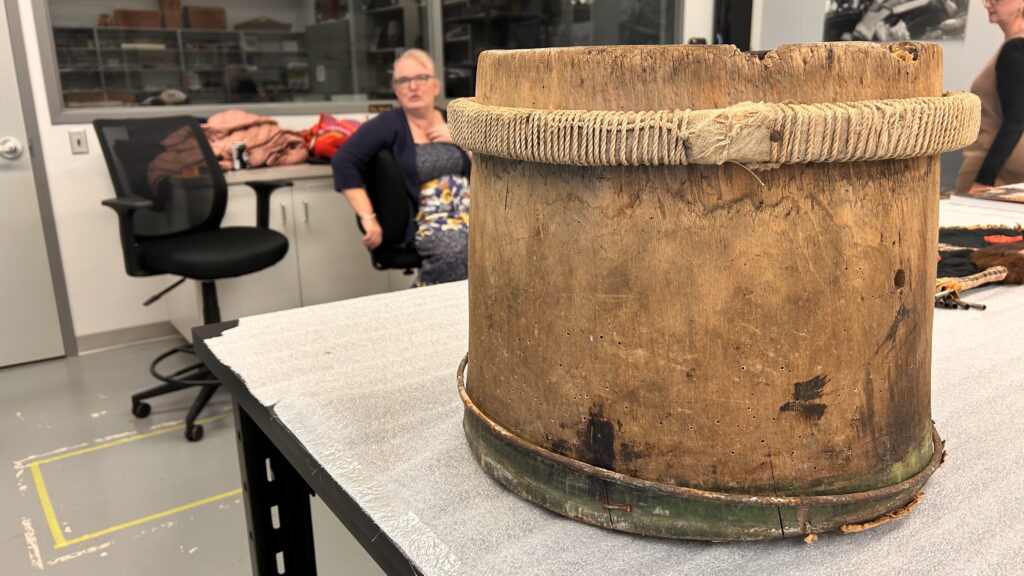
These are items from the collection of artefacts, some of which were stolen at one point.
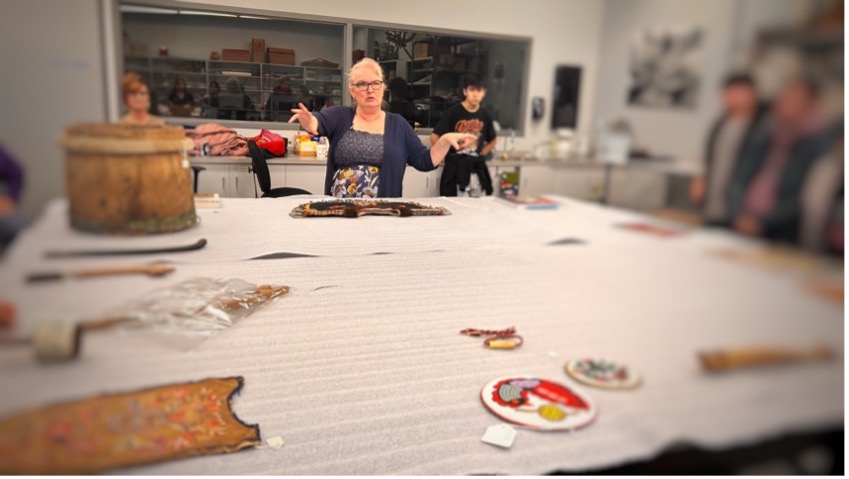
This drum and several other artefacts were held at the University of Winnipeg in their museum at one time. A friend of ours, Maureen Matthews, who works with the school, was preparing a class about them when they discovered that some of the items had been stolen. Someone had decided that because these artefacts were in museums, people didn’t care about them. That’s not true at all.
If you don’t understand Ojibwe culture, you don’t realize, people don’t jump up and down and say, “Hey, pay attention to me.” That’s me. That’s my red hair. My husband’s really calm and quiet.
One day he found an article in a paper called The Drum and it was talking about how some artefacts had disappeared. “Do you want to do something about it?” he said. I said, “Yes. Why don’t you do everything in Ojibwe, and I’ll do everything in English?” That was the best thing we ever did, and it worked very well.
He stood up to the president of the University of Winnipeg and their lawyers and said how important the collection was for preserving the culture and language.
He always talked to Omishoosh about things and before Omishooh had died, he said, “Use the artefacts to teach the children about their history so they don’t forget who they are.”
Dance Cape Belonging to Omishoosh’s Wife Eva
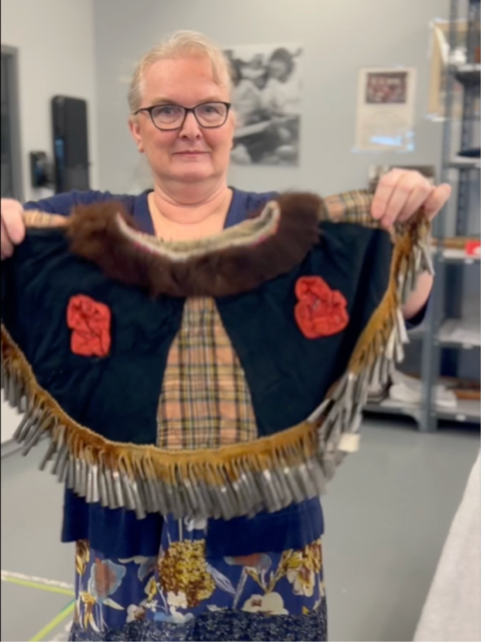
This is her dance cape. It is about 100 years old.
All these little tinklers were hand-made from old cans. In the winter, people would sit and hand cut and hand roll them. They are so evenly made, it’s amazing.
Then they crimped them onto moose hide, and these have been around for more than 100 years. What would happen if this [fabric] part wore out, they would just move the tinklers.
We have a cape in the collection that belonged to a woman from an older generation, and there’s rows and rows of tinklers on the shoulders, and some of them are bigger than these. They’re fabulous. This one is nice but that one is fabulous.
I say I am a bit of a tinkler snob because the new ones that sound so tinny to me, I just (ugh)… So, I’m spoiled. You should think about that too, because this is all connected to you.
Now, back to the drum. The drum was discovered to have been taken over the border. Maureen Matthews found it in Wisconsin.
She saw some of the drumsticks with their museum labels on them, and she did a radio program and spoke about them, and shortly after that radio program, that gentleman from Wisconsin came up here and met my husband.
My husband was a typical Ojibwe man—very quiet; wasn’t loud or anything. They had a conversation in Ojibwe. Ooh, he was angry, but you would never know he was angry. He was just sitting there with a calm face. He kept saying over and over to this other gentleman, “Where did you get this? How did you get this?” He was livid!
A few days later, all of a sudden the drum reappeared, and we were invited to receive the drum back.
Nelson didn’t like to get attention. That’s not the way—you don’t pump yourself up and tell everyone you’re wonderful. So, we went and got the drum, and APTN was there. I kept standing between the camera and Nelson because he was upset.
His grandfather asked us to make a book about these objects. Have you seen the book? There are copies at the school. His grandfather specifically wanted it designed so that children could look at it and read it.
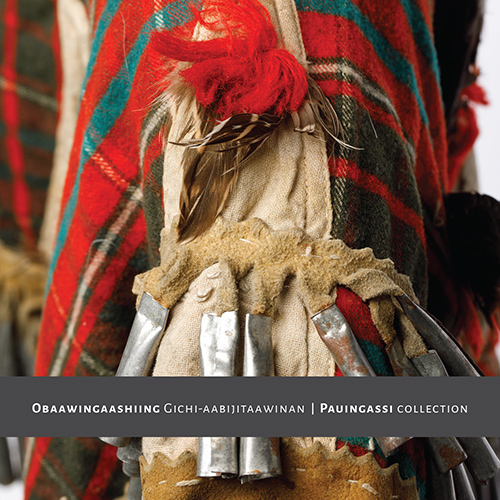
Donate $300 or more to receive a copy of the book: https://pimaki.ca/shop/
One of the things I love about the book is the author page. My name is there, along with my son’s name. We are the guardians of this collection. Our job is to protect these things so that they are not stolen again. That is why they are kept locked up.
You normally can’t just come and see them. Even if you were the Prime Minister, you couldn’t see them unless I said yes. Today, you’re seeing them because you are a part of the families who are connected to these items.
I’m one of the keepers of this collection, and I’m able to share it because I respect Omishoosh and understand how important it is to remember these things.
Embroidered Ceremonial Piece
This ceremonial piece was worn by Oomishoosh We have photographs from the 1930s showing him wearing it during a ceremony. He was raised by his aunt and uncle, who did not have children of their own.
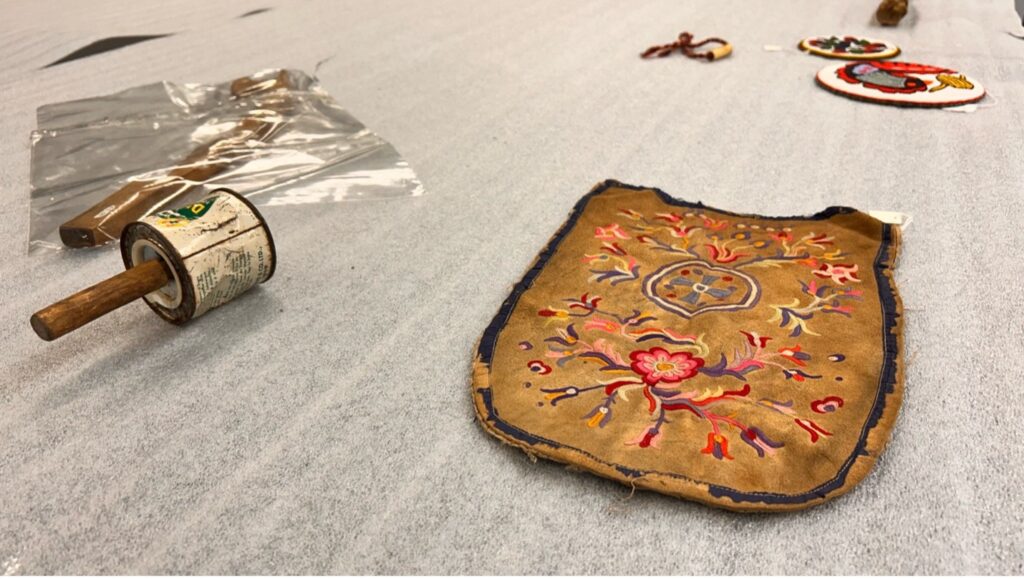
Look at the embroidery. It is remarkable. My mother, who grew up with embroidery, was especially impressed by it because it was a tradition in her family as well.
This particular piece has retained its colour because it was kept indoors and away from direct light. There is also a matching piece that could be worn over the shoulder. It has tinklers made from dewclaws.
Dewclaws
Do you know what a dewclaw is? Animals have them on their legs. In Anishinaabemowin, we talk about animals as having arms and legs, rather than simply front and back legs.
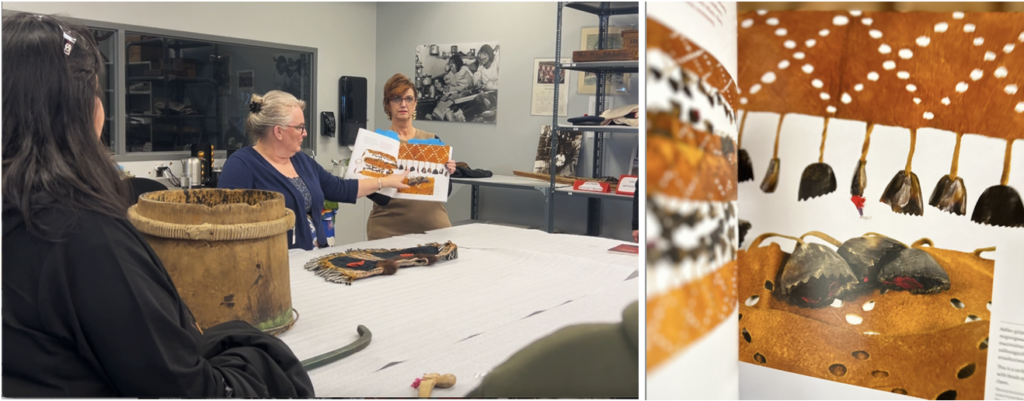
The dewclaws were carved and shaped so that they looked like little bells. When they moved, they tinkled together.
Every time I do one of these presentations, I bring out different objects. So, if you ever have the opportunity to come again, you’ll probably see something different.
Hug Your Grandmas
My husband passed away 15 years ago, but I still want to do this because it is important. It is important for you to understand how significant you are to Manitoba and to your communities, to respect these wonderful objects, and to talk to your grandparents.
I have a rule in my classroom: if your grandmother is in the building, you have to hug her. Grandmothers come into my classroom all the time to teach children how to knit, crochet, and do other traditional things.
Hug your grandmas, because you are here because they were here.
Some traditional things really are better than modern things. As First Nation people, you have a direct connection to knowledge that many other people have lost. You have the opportunity to learn from your Elders, your communities, and the traditions that have been passed down to you.
Remember who you are, take care of these things, and keep learning from the people who came before you.
The Pauingassi collection of artefacts is viewed only on rare and special occasions. Learn more about the collection: